
GST on a solar, battery or hot water job is worked out on the full price, before the discount for small-scale technology certificates (STCs). Working it out on the discounted price underpays the GST on every job.
The rule: GST on the full price
On most jobs, the customer assigns their right to create the STCs to you, or to an agent who creates and sells them, in exchange for a lower price. In effect, the customer pays part of the price with that right instead of cash.
GST law counts a non-cash payment, including the grant of a right, as part of the price. So your GST is one-eleventh of the full price including the STC value, not one-eleventh of the cash the customer pays.
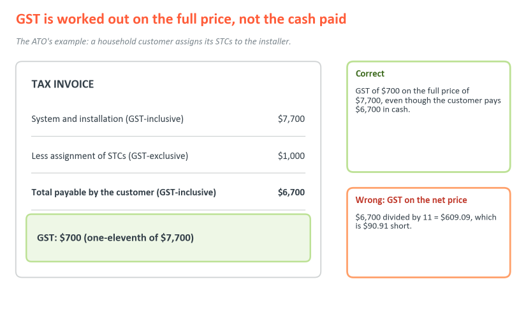
In the ATO's example, a household customer buys a system for $7,700 including GST and assigns its right to create STCs, valued at $1,000, to the installer.
The customer pays $6,700 in cash and the GST is $700: one-eleventh of the full $7,700.
The ATO notes that the GST on the invoice can be more than 10% of what the customer pays. That is correct, not an error.
Working out GST on the net price would give $609.09 (one-eleventh of $6,700), which is $90.91 short. On every job the shortfall is one-eleventh of the STC value, and on a battery job the STC value can run to several thousand dollars.
|
Where an agent pays you instead Sometimes the customer assigns the right to create the STCs to a separate agent, who pays you the discount amount. In the ATO's example the system is $4,400, the customer pays $3,800, and the agent pays the installer $600. The installer still accounts for GST on the full $4,400, which is $400. The agent's $600 is part of that price, not a separate amount with its own GST. |
What the customer's invoice should show
The ATO's model invoice keeps the full price visible. For a tax invoice where an STC discount applies, check that it shows:
- The full GST-inclusive price of the system and installation.
- A separate line for the assignment of the STCs, at the value given for them.
- The net amount the customer pays.
- The GST as a dollar amount. The shortcut statement 'Total price includes GST' only works where the GST is exactly one-eleventh of the total, which it is not here.
- The customer's name or ABN, where the price is $1,000 or more.
The STC value on the invoice should match the assignment form. For solar panels and batteries, that form must state the incentive the customer receives, and for batteries the upfront discount must also be shown clearly against the system price.
You are responsible for valuing the STCs, so keep a record of how you set the value.
When the customer is a registered business
If the customer is registered for GST and uses the system in its business, there are two taxable supplies, each with its own GST: you supply the system, and the customer assigns its right to create the STCs to you.
|
GST item |
Household customer |
Registered business customer |
|
GST on your supply of the system |
One-eleventh of the full price. |
One-eleventh of the full price. |
|
GST on the customer's assignment of its right to create STCs |
None, where the system is not used for business. |
One-eleventh of the value given for the right. |
|
Tax invoice for the assignment |
Not needed. |
The customer issues one to you where the amount is more than $82.50. |
|
Your GST credit for the assignment |
None. |
Claimable, once you hold the customer's tax invoice. |
|
Customer's GST credit on the system |
None. |
Based on the full price before the discount, less any private use. |
The customer's tax invoice for the assignment is easy to miss, and without it you cannot claim the credit.
For the customer's own income tax, the ATO's view is that the right to create STCs is an assessable recoupment (taxable income) where the cost of the system is deductible. That is a point for the customer's accountant.
GST when you sell the STCs
Creating STCs in the Clean Energy Regulator's (CER) online registry is not a GST event. Selling them is: an installer or agent that is registered, or required to be registered, for GST pays GST on any sale or transfer of STCs.
The GST-free rule for emissions units covers only Australian carbon credit units and international units, not STCs.
Normally the seller issues the tax invoice. A buyer that sets the price can issue a recipient-created tax invoice (RCTI) instead, but only where both parties are registered for GST and have agreed in writing. The RCTI must make clear that you, as the seller, pay the GST, and it must reach you within 28 days.
Check the GST settings in your registry account too. The CER cannot adjust a completed transaction if GST was applied incorrectly.
The STC value is fixed at a time that is reasonable in the circumstances. That may be when the binding sale agreement is made, provided the amount reasonably reflects what the STCs were worth then.
If the STCs later sell for more or less because their market value has changed since the value was fixed, the GST on the system does not change. In the ATO's view, a later change in the value of a non-cash payment is not an adjustment event (an event that requires GST already reported to be corrected).
A change to the price you agreed with the customer is different, and can be an adjustment event. The sale of the STCs is a separate supply with its own GST.
If past invoices got it wrong
If GST has been worked out on the net price, the shortfall sits in earlier business activity statements. How it is corrected depends on the amounts and the periods involved, so talk to us before you change anything.
GST questions for every STC job
-
- Is GST worked out on the full price before the STC discount?
- Does the invoice show the full price, the STC line, the net amount payable and the GST in dollars?
- Does the STC value on the invoice match the assignment form?
- If the customer is a registered business using the system in its business, do you hold its tax invoice for the assignment?
- When you sell STCs, is GST included, and is any RCTI backed by a written agreement?
We can help
We can check the GST on your STC invoices and work out how to correct any past periods.